

Shopify Plus plan pricing is one of the most misunderstood topics in enterprise ecommerce. The headline number looks straightforward, but the real monthly spend depends on your revenue, tech stack, and operational complexity. This guide breaks down every cost layer so you can model your actual budget before talking to Shopify sales.
Key Takeaways
Shopify Plus in 2026 starts at $2,300/month on a three-year contract or $2,500/month on a one-year contract, with a variable platform fee kicking in above roughly $800,000 in monthly revenue. Once you add apps, integrations, and custom development, merchants typically spend $4,000 to $10,000+ monthly on Shopify Plus.
- Shopify Plus lowers transaction fees compared to standard Shopify plans and unlocks checkout customization, native B2B features like direct catalog assignment and custom pricing lists, and headless commerce capabilities not available on the advanced plan.
- Total cost of ownership depends heavily on app costs (typically $1,000–$3,000/month), integration costs with ERP and CRM systems, and custom development-especially for B2B and wholesale brands.
- Brands at $1M, $5M, and $10M annual GMV each hit different cost-benefit inflection points where Plus becomes financially attractive over Advanced Shopify due to lower transaction fees and automation gains.
- At Shift8 Web, our senior engineering team in Toronto helps scaling merchants model real Shopify Plus budgets and architect B2B and headless solutions that avoid hidden costs and re-platform regrets.

What Is Shopify Plus and Who Actually Needs It?
Shopify Plus is Shopify’s enterprise plan, designed for high-volume merchants and complex operations. It targets brands doing roughly $1M–$10M+ in annual GMV, or B2B manufacturers needing complex pricing, approval workflows, and deep integrations with systems like NetSuite or SAP.
- Shopify Plus vs Advanced Shopify in business terms: Plus supports multi-store operations via expansion stores, dedicated B2B wholesale portals, advanced checkout experience requirements, and peak-traffic resilience-the platform supports 10K+ checkouts per minute during flash sales and events like Black Friday.
- B2B and wholesale: Plus features a dedicated B2B commerce layer not available on lower Shopify plans, letting you run D2C, wholesale, and retail from the same store.
- Automation over aesthetics: Plus is often justified when teams are bottlenecked by manual operations-spreadsheet-based pricing, manual invoicing, basic Shopify reports-and need Shopify Flow automation and advanced API access rather than just a nicer online store.
- Ideal merchant profiles: Multi-channel brands managing sales volume across D2C, B2B, and Shopify POS; manufacturers with tiered wholesale pricing; companies entering multiple international regions; and teams running on multiple platforms that need consolidation.
Shopify Plus Base Platform Fee in 2026
The Shopify Plus plan starts at $2,300/month on a three-year contract and $2,500/month on a one-year contract. In the EU, pricing lands around €2,100/month on three-year terms. These are the publicly documented base fees as of 2026.
- The monthly platform fee covers core Shopify Plus features: up to 9 free expansion stores for multi-store management across different currencies and languages, unlimited staff accounts, Shopify Flow automation, Launchpad for scheduling flash sales, custom checkout customization, and priority chat support.
- This base platform fee does not include payment processing fees, third party apps, migration costs, or custom development. These are the layers that push real cost significantly higher.
- Most merchants sign at least a one-year term. Larger brands often negotiate shopify plus contract terms at three years to lock in lower pricing or better variable fee tiers.
- Premium themes for Shopify Plus cost between $250 and $400, which is a minor one-time cost but worth noting when budgeting initial development.
Variable Platform Fees and Revenue-Based Pricing
Shopify Plus has a variable platform fee for high-volume merchants. Once your monthly GMV exceeds a threshold-commonly cited around $800,000/month-Shopify charges a percentage on the revenue above that mark, layered on top of the base platform fee.
- The variable fee activates after approximately $800,000 in monthly revenue. Shopify Plus charges 0.35% of sales for a three-year contract after the threshold, or roughly 0.40% on a one-year contract.
- Shopify Plus caps the variable fee at $40,000 per month, which limits runaway costs for very high-volume enterprise merchants.
- Example: A brand doing $1M/month GMV on a three-year term would pay the base $2,300 plus 0.35% on the $200,000 above the $800K threshold-an additional $700, bringing the total platform fee to roughly $3,000/month.
- Some contracts use slightly different thresholds or percentages (e.g., 0.25% or bespoke bands). Merchants should treat all public numbers as guidance only and negotiate Shopify terms directly with the sales team. Partner consensus on these ranges is quite consistent, but your specific contract may differ.
What’s Included in Shopify Plus (and What Isn’t)
Shopify Plus includes most of the platform features a high-growth merchant needs out of the box, but key capabilities like advanced search, subscriptions, and ERP-grade operations still require paid apps or external systems.
- Core inclusions: 9 expansion stores, advanced Shopify admin tools, Shopify Flow, Launchpad, Scripts and Functions for promotions, B2B on Shopify, lower transaction fee structure, advanced bot protection, smarter analytics, and priority support with a merchant success manager.
- Shopify Plus allows unlimited staff accounts and higher API limits compared to standard plans. The platform also supports multi-store capabilities for managing different currencies and languages, plus unlimited staging stores for development.
- Shopify Plus provides automated tools for optimizing workflows and campaigns, including specific Shopify notification emails, customer segments, and Shopify Academy access for team training.
- What’s not included: themes, most apps in the app ecosystem, complex reporting tools, social commerce integrations, and external systems like NetSuite or SAP. These appear as separate line items in any honest TCO view, alongside new platform features that may require custom storefronts or development work.
Checkout Customization and the Checkout Experience on Plus
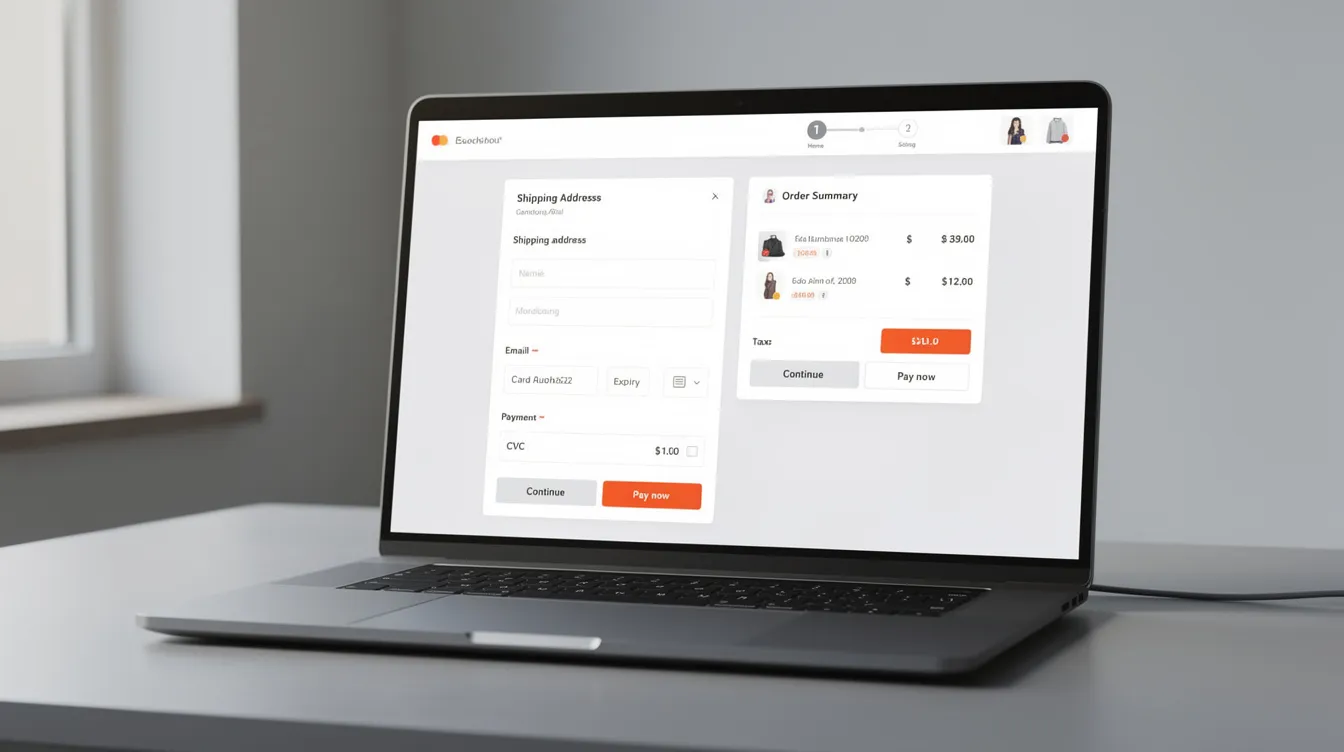
Shopify claims to operate the world’s highest-converting checkout page, and Shopify Plus extends this via Checkout UI extensions, Functions, and granular configuration through the Checkout Branding API. This is where Plus meaningfully separates from core Shopify offerings.
- Plus lets you add checkout blocks like loyalty widgets, custom fields (PO numbers, VAT IDs), upsells, and dynamic messaging directly in the checkout experience, while lower plans mostly support cosmetic branding changes.
- Legacy checkout.liquid has been fully deprecated as of August 2025. Merchants planning custom checkout work in 2026 must architect against the new extensibility stack-Checkout UI Extensions and Web Pixels.
- Shopify Plus offers a customizable checkout experience through Checkout Extensibility. Improving the checkout experience can lift conversion by 5–20%, which at $5M–$10M GMV easily covers the entire base platform fee through incremental online sales.
- Serious checkout customization almost always requires an experienced Shopify Plus developer or agency. Budget for this in your development line items, not as an afterthought.
Payment Processing and Lower Transaction Fees
Shopify Plus plan pricing does not include credit card processing. You pay payment processing fees separately through Shopify Payments or an external payment gateway, and these charges significantly affect total cost.
- In the US market, Shopify Payments rates on Plus run approximately 2.15% + $0.30 per domestic online transaction. Exact numbers differ by country and contract. Merchants using Shopify Payments incur no additional transaction fees from Shopify itself.
- When merchants use a third-party gateway, Shopify Plus charges 0.15% to 0.20% per order on top of whatever the gateway charges. Compare that to Advanced Shopify’s 0.5–0.6% surcharge-a significant gap at scale.
- At $1M/month GMV: processing at ~2.15% costs roughly $21,500/month. On Advanced Shopify with a third-party gateway, the additional Shopify fee alone would be $5,000–$6,000/month. On Plus, that drops to $1,500–$2,000. The savings: $3,500–$4,000/month.
- At $5M–$10M/month GMV: those savings multiply to $17,500–$40,000/month-easily exceeding the entire platform fee. This is why enterprise merchants running high sales volume through Shop Pay or Shopify Payments find Plus financially compelling once they cross the $500K–$800K/month threshold.
Additional Costs: Apps, Integration Costs, and Headless Commerce
Most Shopify Plus merchants spend significantly more on their tech stack than on the base platform fee. Merchants may incur additional costs for apps and integrations beyond the base subscription fee, and these are the real drivers of total cost of ownership.
- App costs: mid-market Plus stores often spend $1,000–$3,000/month on paid apps for subscriptions, loyalty, advanced search, reviews, bundling, and marketing automation. More complex setups with heavy personalization or shipping logic can exceed $5,000/month in recurring app and vendor costs.
- Integration costs: connecting your Shopify store to ERP systems (NetSuite, SAP, Microsoft Dynamics), CRM platforms (HubSpot, Salesforce), and 3PL/WMS systems often requires a one-time project in the $15,000–$60,000+ range, plus ongoing maintenance to keep data flowing.
- Headless commerce: custom storefronts built with React, Next.js, or Hydrogen add another layer. Initial builds can run $80,000–$250,000+ depending on complexity, with monthly hosting and DevOps costs on top. Custom development for Shopify Plus in these scenarios can exceed $50,000 for the front-end alone.
- Not every merchant doing $1M GMV needs headless commerce on day one. Too many apps or poorly designed integrations increase both app costs and hidden costs like debugging, downtime, and vendor lock-in.
Migration Costs and Hidden Costs When Moving to Shopify Plus
Shopify itself doesn’t charge a migration fee, but real-world migration costs typically fall between $10,000 and $75,000 depending on scope, design requirements, and integrations.
- Typical cost components: data migration (customers, orders, products, content), theme or UX redesign, custom functionality rebuilds from Magento, WooCommerce, or BigCommerce, and QA plus performance testing.
- Migration costs spike when merchants have custom logic-tiered pricing, complex promotions, B2B account hierarchies-that must be re-implemented using Shopify Plus features, custom apps, or Functions.
- Hidden costs to budget for: internal team time for UAT, content rewriting, SEO redirect mapping (critical if URL structures change), analytics migration, and temporary drops in organic traffic. These are routinely underestimated.
- Working with a seasoned agency reduces migration risks by making early architecture decisions around data models, integrations, and checkout experience. Replatforming once, correctly, is always cheaper than a rushed migration followed by rework.
B2B and Wholesale Pricing on Shopify Plus
Shopify’s B2B on Shopify (Plus-only) features let merchants run wholesale and D2C from the same store with customer-specific price lists, payment terms, and account structures. This is a distinct business model capability that doesn’t exist on lower plans.
- Key B2B pricing capabilities: company profiles with multiple locations, custom pricing lists for wholesale customers, B2B features including direct catalog assignment, payment methods like purchase orders and bank transfers, and order-level rules for MOQs and case packs. Shopify Plus supports bulk ordering for B2B customers and includes unlimited catalogs for B2B operations.
- Partial payments and payment requests are available for B2B transactions, alongside Net 30/60 terms-features that let you exclude existing customers from D2C promotions while serving wholesale buyers with entirely different pricing structures.
- Serious B2B brands often need custom storefronts or portals layered on top of native tools, particularly for quoting workflows, contract pricing, and tight ERP integration. Case studies like Cornerstone Trade Group-which mapped 12 distinct pricing tiers across 1,200 trade accounts-show how these builds achieve measurable ROI (64% faster order processing, $1.4M incremental orders in six months).
- Integration costs for B2B-syncing quotes, credit limits, inventory, and invoices between Shopify Plus and ERP-can land in the $25,000–$100,000+ range depending on whether you use middleware connectors (Celigo, Boomi) or fully custom APIs.
- At Shift8 Web, our senior engineering team has implemented complex B2B and wholesale portals with modular ERP connector architecture. If you’re evaluating this path, our Shopify Plus developers can help you integrate Shopify with your existing systems without building monolithic dependencies.

Headless Commerce and Custom Storefronts: When Does It Make Financial Sense?
Headless commerce on Shopify Plus means using Shopify purely as a backend for products, checkout, and orders while building custom front-end experiences in frameworks like Next.js, Remix, or Hydrogen. It decouples the Shopify storefront from the commerce engine.
- Headless triggers: multi-region content experiences, complex content modeling, lightning-fast performance requirements, non-standard storefront UX, or integrating digital commerce features into native apps and in-store kiosks.
- Budget guidance: headless builds for Shopify Plus commonly start around $120,000 for mid-market brands and can exceed $400,000 for multi-brand, multi-region experiences. Monthly hosting and DevOps costs layer on top.
- Headless projects also increase app and integration costs because features like search, personalization, and content management often require separate services (Algolia, Contentful, custom APIs) with their own subscription fees.
- For brands under roughly $5M GMV, a well-architected Online Store 2.0 theme on Plus often provides enough flexibility at far lower cost. Headless should be treated as an architectural strategy, not a vanity upgrade.
Realistic Total Cost of Ownership at Different GMV Levels
Modeling Shopify Plus pricing across specific GMV tiers helps decision-makers see when Plus becomes financially compelling versus staying on Advanced Shopify. Here’s what the numbers look like in practice.
- $1M/year (~$83K/month): Base platform fee of $2,300–$2,500, conservative app costs of $800–$1,500/month, payment processing at ~2.15%. Total monthly spend lands around $3,500–$5,000. At this level, Plus is chosen for capabilities (B2B, automation, checkout branding) rather than pure cost savings on lower transaction fees.
- $5M/year (~$416K/month): Lower transaction fees save $2,000–$4,000/month versus Advanced Shopify. App stack runs $2,000–$4,000/month. With automation reducing manual labor across customer data management and order processing, Plus typically pays for itself. Total recurring cost: $8,000–$15,000/month.
- $10M/year (~$833K/month): The variable platform fee begins to apply. Total platform cost (base + variable) approaches $3,000–$3,500/month. Combined with processing and a $3,000–$5,000 app stack, monthly spend runs $15,000–$25,000. At this level, the $40,000/month cap on the variable fee provides meaningful cost certainty.
- Beyond $10M GMV, most brands also layer in ERP systems, advanced customer data platforms, and sophisticated analytics. These should be bundled into your TCO model rather than treated as separate initiatives.
When to Upgrade to Shopify Plus vs Staying on Advanced Shopify
The right time to upgrade is a mix of revenue thresholds and operational needs. Flat fee savings on transaction rates alone are rarely the only factor.
- Staying on Advanced: generally appropriate below ~$1M/year GMV if needs are straightforward D2C with no immediate B2B, heavy checkout customization, or multi-store requirements.
- Considering Plus: common once brands pass $1M–$3M/year and are constrained by checkout page limitations, B2B workflows, multi-store operations, or manual processes that Shopify Flow could automate.
- Strong case for Plus: at $5M–$10M+ GMV, where the combination of lower transaction fees, automation, and scalability clearly outweighs the jump from the advanced plan at $399/month to $2,300+/month.
- Non-financial triggers: needing advanced checkout customization, launching serious B2B channels, entering multiple international regions with expansion stores, or needing to integrate Shopify with ERP and warehouse systems.
- At Shift8 Web, we regularly help merchants run break-even analyses comparing Advanced Shopify vs Plus based on concrete numbers-GMV, average order value, payment mix, and Shopify sales channel distribution-rather than gut feel.
Working with a Technical Agency Like Shift8 Web
Shift8 Web is a Toronto-based agency of senior technical engineers and Shopify Plus specialists. We combine design, branding, and deep engineering to deliver complex Plus builds, B2B portals, and headless commerce projects-not template installs.
- One-time project budgets: full Shopify Plus builds or migrations typically range from $40,000–$150,000+ depending on scope, with initial development covering architecture, design, custom apps, and ERP connectors.
- Ongoing retainers: continuous improvement at 20–80 hours/month covering CRO experiments, new features, performance optimization, and maintenance of your Shopify account infrastructure.
- Strategic architecture work: choosing the right mix of native features vs apps vs custom code to minimize hidden costs, prevent vendor lock-in, and ensure your pricing structure scales with your business.
- Our background in WordPress, WooCommerce, and Laravel applications also helps merchants who are replatforming to Shopify Plus from those ecosystems, where translation of custom logic and data migration are critical. If you need Toronto Shopify developers who understand both sides of a migration, we can build a tailored cost model for your specific scenario.
Is Shopify Plus Worth the Investment in 2026?
Shopify Plus is usually worth the investment for brands with complex operations or GMV above $1M–$3M/year. For stores with simple catalogs and modest revenue, it’s overkill.
- Worth it when: high GMV where lower transaction fees and automation materially improve margin; brands needing serious B2B features and wholesale portals; companies planning multi-region, multi-brand strategies; and teams that will actively use tools like Shopify Flow, checkout customization, and customer segments.
- Likely not worth it when: early-stage D2C brands under $1M/year, businesses with very simple catalogs, or teams not prepared to invest in ongoing development and optimization of their Shopify storefront.
- The smartest approach is evaluating Shopify Plus as part of a full TCO model-including apps, integration costs, migration costs, and internal staffing-rather than anchoring solely on the $2,300/month headline on the pricing page.
- Before signing a multi-year contract, consult experienced Shopify Plus developers for a tailored financial model and architectural roadmap that accounts for your actual revenue, your existing customers, and the additional costs that most merchants underestimate.